Mental Models for Decision Making
12/24/2025
This post is an explanation of how I've been using mental models for decision making. I'd like feedback on my decision making processes, and maybe change the way you're thinking about a decision.
First, what are mental models and why do they matter? Mental models are ways of approximating how the world works in your mind. For example, in The Design of Everyday Things, Don Norman describes a simple mental model many people use for their thermostat, that the temperature on its display controls the temperature of the air coming out of your heaters. Based on this mental model, you might intuit that turning the temperature higher will make the room warm up faster.
This is in fact an inaccurate mental model for most heating systems. The way that most of them really work is that the number you set it to acts as a threshold. When the thermostat notices that the room has reached the temperature it is set to, it shuts off the heat. If the temperature drops below the threshold again, the heat is turned back on. The temperature of the air coming out is always the same. Turning up the heat does not make the room heat up faster.
We all go around with many mental models that are incorrect, like this one. As a consequence, we press the wrong levers in our lives or avoid topics we're confused about. On the other hand, a good set of mental models gives us confidence, a sense of control, and satisfaction.
I've been confronted by big decisions lately. They're related to who I am going to be spending time with, where to live, my career, and how I should think about spending or saving money. These decisions have made me curious about using mental models for decision making. What follows is a set of ways I think about my decision making process.
Day One Thinking
That brings me to the first mental model on my list, that has been helpful in re-engaging me with my life, every day. I'm directly borrowing it from Jeff Bezos (don't let that deter you!), along with lessons from Buddhism and my observations about consciousness. It's the idea of Day One thinking. Day One thinking means that it is always the first day of the rest of your life. Actually, it's always the first moment of the rest of your life.
This is to say that it is always possible to start again. In fact you are already starting again, whether you realize it or not. All of your thoughts about the past and the future are simply thoughts that don't actually need to have a bearing on what you do next. The only thing that we can know for sure is true is this moment. Everything else might not be.
I've found myself applying this insight on a daily basis in micro decisions. When I find myself getting caught up in minutiae, doing things hastily, losing focus, or being less kind to myself or someone else than I can be, I remind myself that I'm starting over. Now.
As it applies to "bigger" decision making (I put bigger in scare quotes because arguably the micro decisions are more important than the macro), Day One thinking means that it is always possible, and in fact important, to question your fundamental assumptions.
You can decide to go down a dramatically different path, if you find it more compelling today than it was before. Reminding myself of this recently, I began to question the work I was doing, who I was working for, and why.
I realized that I was becoming attached to a company that, for reasons I won't go into, was not right for me. In my circumstances, it was surprisingly difficult to convince myself to change routes. In retrospect, it's clear I had been living in naive optimism that things would get better, despite all the signs that they would not. I convinced myself that things were OK.
Truth be told, I'm still balancing the mindset of things being OK and taking action to change them. I can see how constant dissatisfaction would lead to a life of, well, constant dissatisfaction. But I also think we have the tendency to think everything is OK and go along with it. Therefore, consciously biasing more towards action might actually create a better balance. If we do, we might just have a better life, and still be satisfied enough to enjoy it.
One Way and Two Way Doors & Reversibility
The second mental model I've been using to think about decisions is the concept of one way and two way doors (also borrowed from Amazon). This is the idea that there are two classes of decisions. Some decisions are like two way doors. You can easily go into and out of them. They're easily reversible. One way doors, on the other hand, are hard to reverse. Once you pass through, you're on the other side for good.
Two ways doors should be passed through often and don't require as much thought. If we go through them and we don't like the outcome, we can reverse it. On the other hand, if we give them too much mental energy, we fail to make progress. I think most people and organizations don't consider the reversibility of their actions enough. Consequently, they waste energy on gathering all the information they need to make great decisions that are easily reversible.
One practical way to limit your energy waste is to think through how you can reverse decisions when you find yourself getting stuck. Oftentimes, the feeling of "stuckness" only arises when our subconscious is telling us there's some hidden way to move past it. When you feel that, listen to it. Take some time to list out the ways to reverse your decision. Be creative. How hard are they to do, actually?
If the decision still appears irreversable, you can feel OK with being stuck. Allow yourself to take time with the decision making process and hold yourself to a higher standard of thinking.
Decision Trees
For both one way and two way doors, a helpful mental model for your decision is to visualize it as a tree. Below is an example of such a visualization.
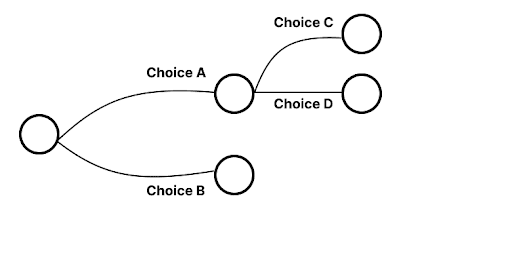
Following the above example, your thought process would be something like, "if I make choice A, then I can do C and D afterwards. Meanwhile, if I decide to do B, I don't have other options." At the same time, you might visualize the tree or draw it out. I like this approach to decision making because it gets me thinking about second and third order effects. By default, we over-weight first order effects for no good reason.
One helpful way to incorporate decision trees into your decision making, is to just ask yourself the question before making a choice, "and then what?" Then ask it again, and again. Even if you don't visualize a tree, it's helpful to think two or three steps ahead.
An area where decision trees are helpful is deciding how to approach touchy conversations. When I find myself confronted by a difficult topic I think I have to bring up, I ask myself, how is the other person probably going to feel? How might they respond? In that case, how will I feel and how will I respond? This line of questioning has helped me avoid getting into conversations I would have rather avoided! It's also a memorable way to be more empathetic.
Inversion
A final technique to making decisions that I want to learn to use more is inversion. Inversion is when we come up with a creative way to turn problems on their head. One general (and not very creative) way I've been using inversion is to ask myself whether the decision I'm about to make is a bad one, instead of asking if I'm making the "optimal" choice. If the answer is "no, this is not a bad decision", then I'll probably be fine. You can be very wise if you avoid doing the wrong thing, rather than seeking out doing the totally 'right' thing all the time and obsessing over it.
Request for comments
Firstly, I'm curious about what mental models you use for decision making and what you think of the above collection. What are some big decisions you've made recently, and how have you approached them?
Do you follow your gut or ignore it? Why?
How much do you rely on others for decision making? What should their role be?
What is the right frame of mind to make a decision?
Taking a step back, what makes a decision 'good' or 'bad'? Is there any right answer?
How do you balance taking action with feeling contentment and satisfaction with where you are?